
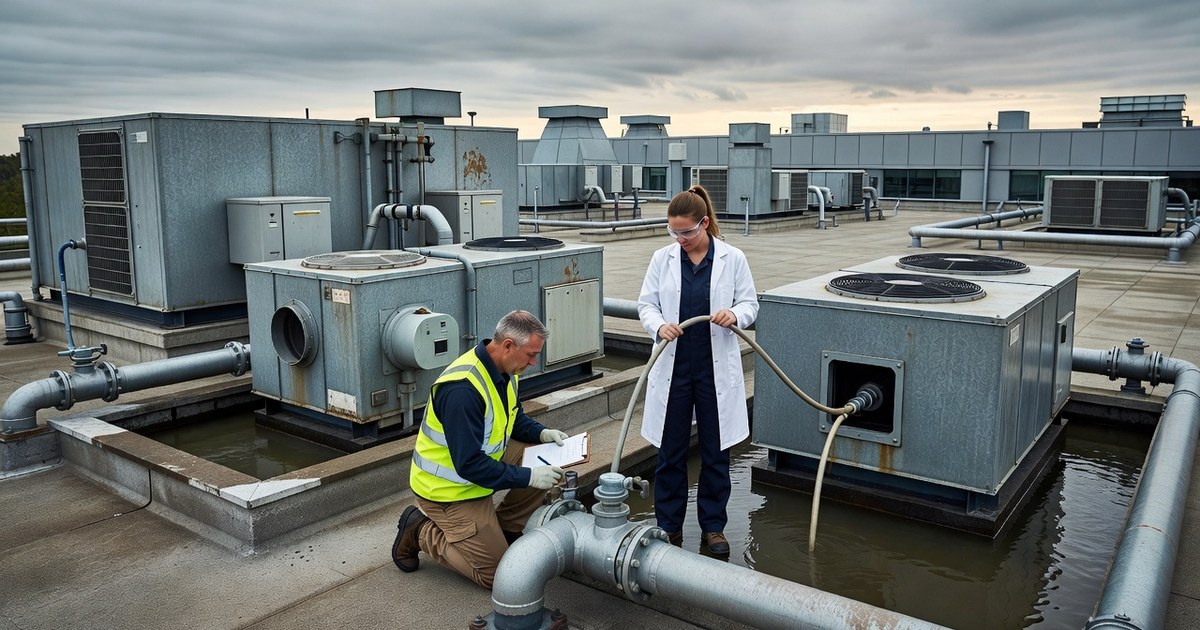

Commercial building owners carry a legal duty to control Legionella, and the risk is easy to underestimate because it is invisible. The bacteria multiply in warm, stagnant water and reach people as a fine mist from showers, taps and cooling systems. A legionella risk assessment is how an owner finds out where a building is vulnerable before anyone falls ill, and it is the starting point for every control measure that follows.
What a Legionella Risk Assessment Covers
The assessment looks at the whole water system, not just the obvious equipment. A competent assessor traces the cold water storage, the hot water cylinders, the pipework between them and any equipment that creates a spray, then records where conditions allow bacteria to grow. Temperature is the central question. Legionella grows in the range roughly between 20 and 45 degrees Celsius, so cold water that runs warm and hot water that does not stay hot are the findings that matter most.
The assessment also records how the building is used. A hotel with rooms that sit empty for weeks, a care home with vulnerable residents and an office with a rarely used kitchen all carry different risk, because stagnation and the people exposed are different. The written result should name a responsible person, list the controls required and set a date for review.
Where Legionella Takes Hold
The common sources are consistent from building to building. Hot water tanks that are not kept hot enough, cooling towers and evaporative condensers, showerheads and taps that are used rarely, and long pipe runs with dead legs where water sits unused. Any of these can hold a bacterial population that a flush of fresh water does not remove, because the bacteria live in the biofilm on the pipe surface.
Dead legs deserve particular attention. These are sections of pipe left over from alterations, capped off or serving a fitting that is no longer there. Water in them never moves. Removing a dead leg is one of the cheapest and most effective actions that an assessment can recommend.
The Legal Framework for Owners
In the United Kingdom the duty sits under the Health and Safety at Work Act and the Control of Substances Hazardous to Health Regulations. The Health and Safety Executive's Approved Code of Practice, known as L8, sets out what a dutyholder is expected to do, and its supporting guidance, HSG274, gives the practical detail on temperatures, testing and inspection frequencies. Owners should read the version that applies to their building type and keep the assessment current.
An assessment is not a one-time document. It needs reviewing when the water system changes, when the use of the building changes, or when monitoring results suggest the controls are not working. Many owners treat a review every two years as the minimum and shorter intervals for higher-risk premises.
Controlling the Risk Day to Day
Controls are mostly routine and inexpensive. Keep hot water stored at a temperature that suppresses growth and distribute it so that it reaches outlets hot. Keep cold water cool. Flush outlets that are used infrequently on a set schedule and record that it was done. Clean and descale showerheads and taps. Keep tanks covered and free of debris, and keep a log of temperature checks so a drift can be seen early rather than discovered after an incident.
Training matters as much as equipment. The person responsible for the system should understand what the checks are for, and anyone who carries them out should know what a failing reading looks like and who to tell. A log that nobody reads protects nobody.
Acting on a Positive Result
When sampling finds Legionella, the response should already be written down. The assessment should say who is informed, which outlets are taken out of use, how the system is disinfected and when it is retested. Acting quickly limits exposure, and a documented response is what an owner will be asked to show if anything goes wrong.
Protecting a building from Legionella comes down to knowing the system, keeping water at the right temperature and moving, and recording what was done. An owner who does those three things consistently is in a far stronger position than one who relies on the assessment sitting in a folder.